Manufacturers evaluating a new automation project often encounter three terms: distributed control system (DCS), programmable logic controller (PLC), and supervisory control and data acquisition (SCADA). Although these technologies can work together, they are designed for different control requirements, plant sizes, and operating environments.
Understanding the difference is important before you invest in a new system, upgrade a legacy installation, or expand your production capacity. The right architecture can improve efficiency, strengthen safety, reduce waste, support precise quality control, and provide a practical foundation for future needs.
At Complete Control Solutions (CCS), we help manufacturers analyze their current systems and select an approach aligned with their specific needs and expectations. Whether you require PLC programming services for a single machine, a plant-wide process control strategy, or a SCADA platform for distributed assets, our engineers provide support from start to finish.
What Is a Distributed Control System?
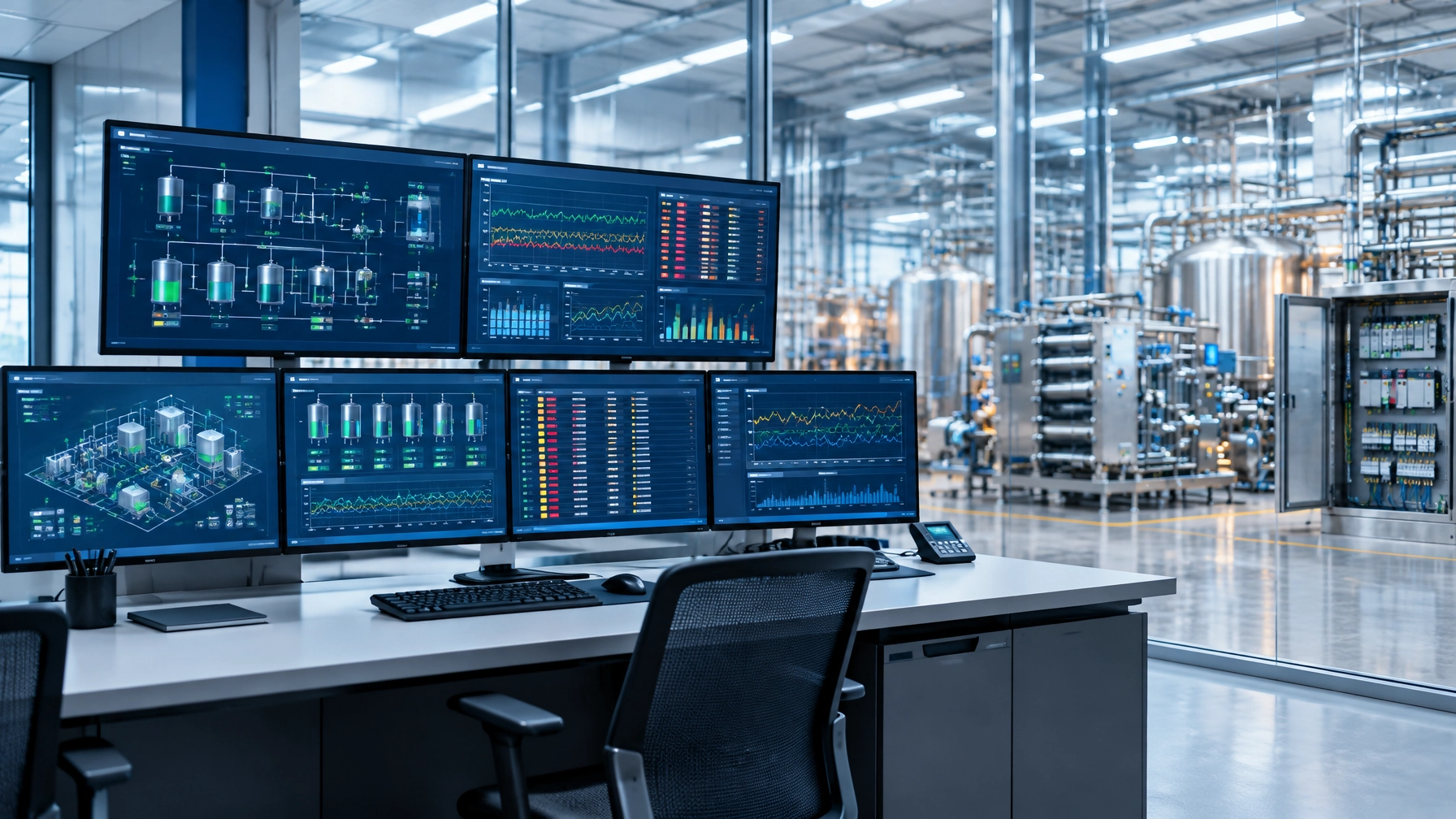
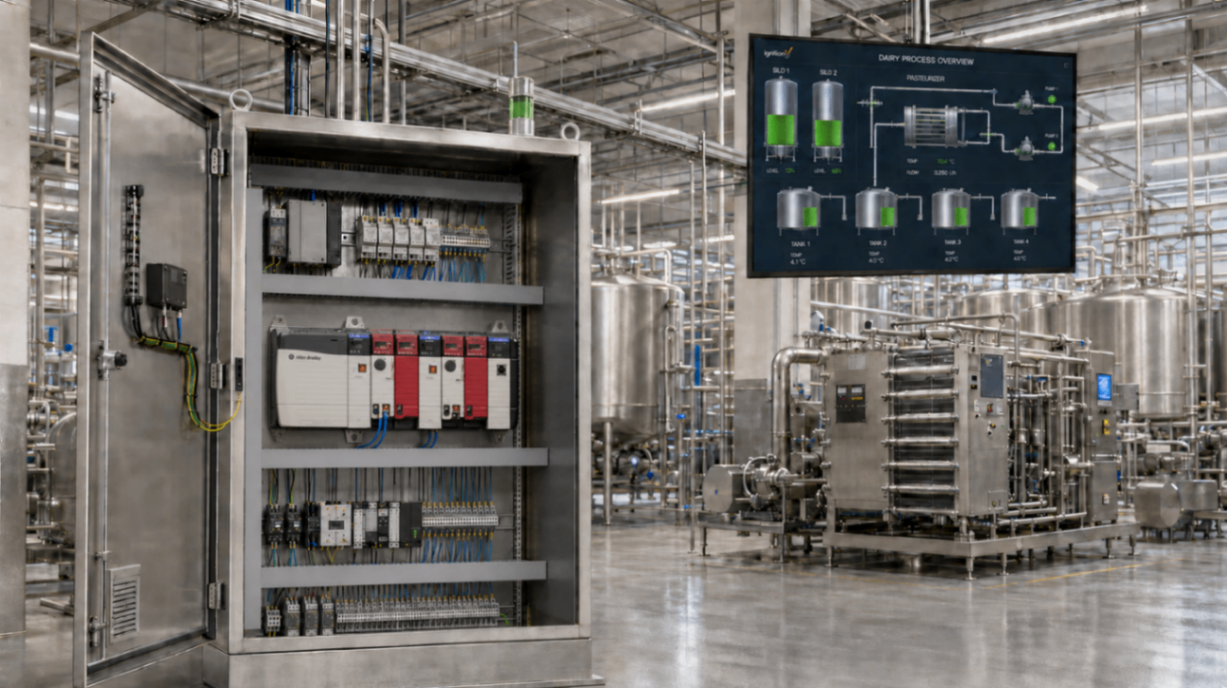
A distributed control system is a computerized industrial control platform designed to manage complex processes across a plant or facility. Instead of relying on one central controller for every operation, a DCS distributes control functions among multiple controllers located near the equipment or process areas they manage.
These controllers communicate over a dedicated industrial network while operator stations, engineering workstations, historians, alarm systems, and reporting tools provide centralized visibility.
A typical DCS may manage:
- Temperature, pressure, flow, and level control loops
- Batch sequences and recipes
- Pumps, valves, drives, and other process equipment
- Alarm management and operator notifications
- Historical process data and production trends
- Interlocks and coordinated process functions
- Interfaces to manufacturing and enterprise systems
The term “distributed” refers to the location of the controllers and control functions. The system remains coordinated from the operator’s perspective, but control responsibilities are divided among multiple areas of the facility.
DCS platforms are commonly used in continuous and batch process industries, including chemical manufacturing, power generation, refining, food and beverage, pharmaceuticals, pulp and paper, and other operations where process stability and high availability are critical. ABB describes a DCS as the central brain of a plant because it coordinates many aspects of production in real time.
How Does a DCS Architecture Work?
A DCS typically includes several connected layers:
- Field devices – Sensors measure process conditions such as temperature, pressure, flow, and level. Actuators, control valves, pumps, and drives respond to control commands.
- I/O and local controllers – I/O modules receive field signals, while controllers execute logic, PID loops, sequences, and other control strategies.
- Control network – Industrial Ethernet, fiber, or other secure communication infrastructure connects controllers, servers, operator stations, and engineering tools.
- Operations layer – Operators use HMI workstations to view process graphics, adjust setpoints, acknowledge alarms, and monitor trends.
- Information and integration layer – Historians, reporting tools, manufacturing systems, and business applications use process data for analysis and decision-making.
Redundancy is also common in DCS environments. Depending on the process requirements, manufacturers may use redundant controllers, network paths, servers, power supplies, or operator stations. This helps limit the impact of an individual component failure and supports reliable operation.
The specific architecture depends on your process, safety standards, production goals, existing equipment, and future expansion plans. A DCS is not simply a larger PLC installation; it is an integrated control environment designed to manage many interconnected process functions.
DCS vs. PLC: What Is the Difference?
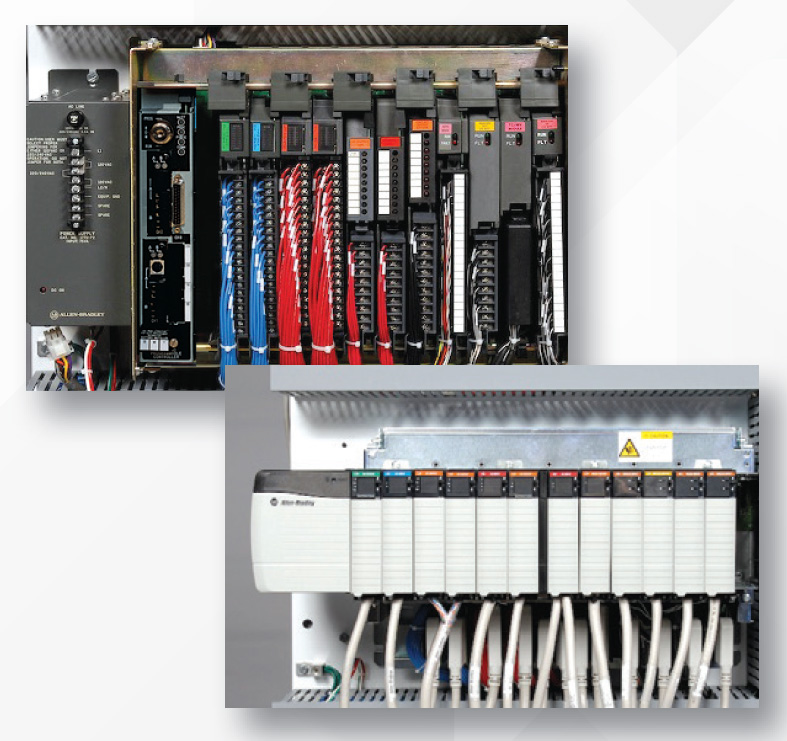
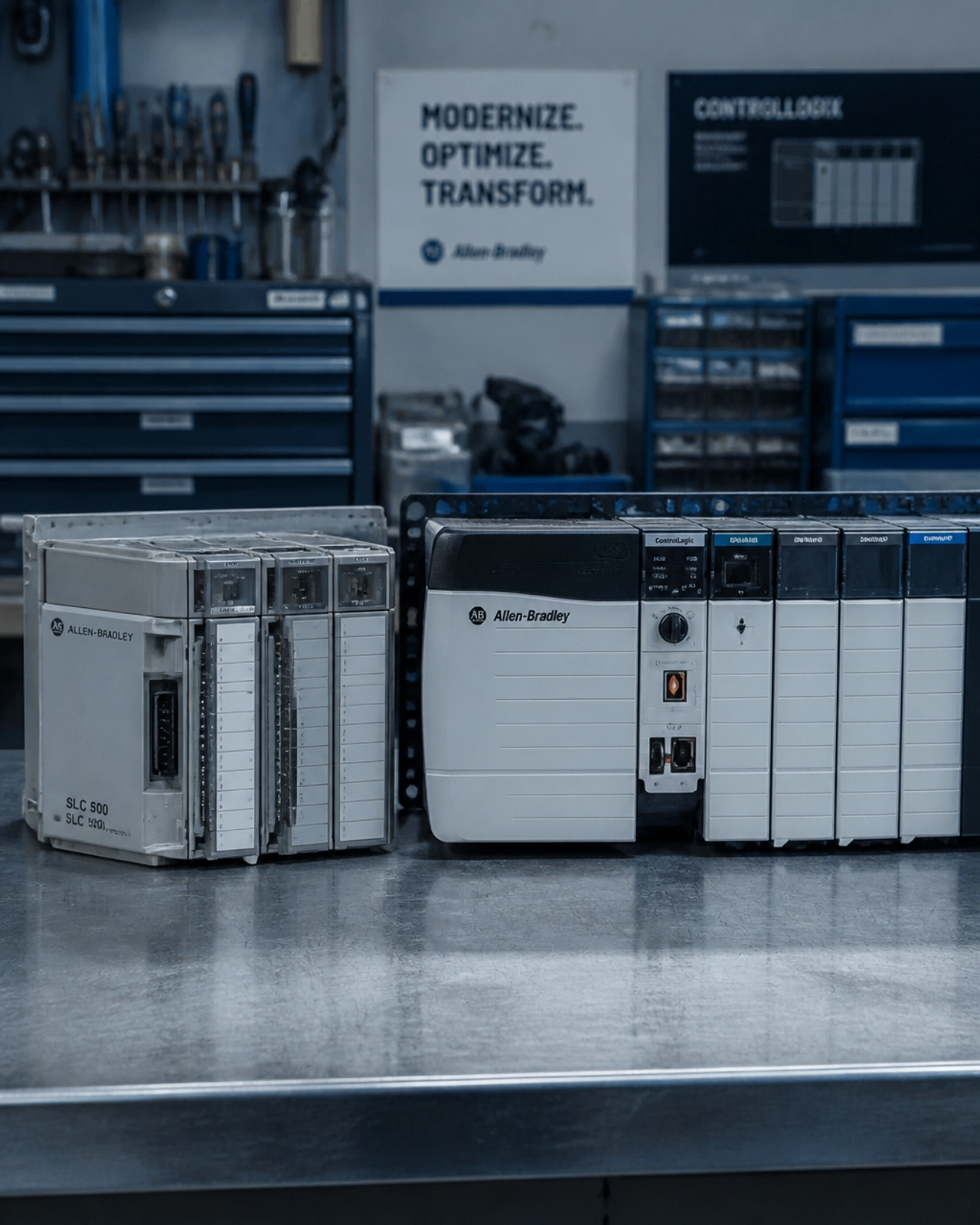
A PLC is an industrial controller programmed to execute a specific set of control tasks. PLCs are widely used for machine control, discrete automation, motion applications, packaging equipment, material handling, and equipment skids.
A PLC continuously reads inputs, executes its program, and updates outputs. For example, it may start a motor when a sensor is triggered, stop a conveyor when a fault occurs, or coordinate the steps in an automated assembly sequence.
The differences among DCS, PLC, and SCADA architectures are primarily related to control function, system scale, geographic scope, and purpose:
DCS vs. PLC vs. SCADA: Key Differences
| Consideration | DCS | PLC | SCADA |
|---|---|---|---|
| Primary role | Plant-wide or unit-wide process control | Machine, equipment or cell-level control | Supervisory monitoring, data acquisition and remote control |
| Typical applications | Chemical, power, food processing, pharmaceutical and other process operations | Packaging, assembly, material handling, motion systems and discrete equipment | Water and wastewater, utilities, pipelines, remote infrastructure and multi-site operations |
| Control focus | Continuous and batch control, analog loops, sequences and integrated alarms | Discrete logic, interlocks, equipment sequencing, motion and localized process control | Supervising PLCs and RTUs while managing alarms, trends, data and operator commands |
| Controller location | Distributed controllers located near process areas | Controllers located within machines, panels, skids or production cells | Relies primarily on connected PLCs, RTUs and field devices for direct control |
| Operator interface | Integrated operator stations, process graphics, alarms, trends and historian tools | Local HMI or SCADA platform commonly configured separately | Centralized dashboards, process graphics, alarms, trends, reports and remote access |
| Geographic scope | Typically deployed within a plant or industrial facility | Typically deployed on an individual machine, skid, cell or production line | Can supervise facility-wide or geographically distributed assets across multiple locations |
| Scale | Multiple process areas and potentially thousands of control points | One machine, skid, line or coordinated equipment group | From a single facility to extensive networks of remote sites and assets |
| Data management | Integrated historian, alarm management, reporting and process information | Controller data is commonly passed to separate HMI, historian or reporting systems | Centralized collection, visualization, storage and reporting of data from multiple controllers |
| Availability | Often includes integrated controller, network, server and power redundancy | Redundancy is available when required but is typically configured for the application | Server, network and communication redundancy can be configured for critical supervisory systems |
| Expansion | Designed for coordinated plant-level growth | Expanded through additional controllers, I/O, networks or integrated platforms | Expanded by adding PLC or RTU connections, tags, servers, clients and remote sites |
| Best fit | Complex continuous or batch processes requiring coordinated, high-availability control | Direct, deterministic control of machines, equipment and production cells | Centralized visibility and supervisory control across multiple controllers, facilities or remote assets |
Modern PLCs are capable of advanced analog control, motion, networking, and data handling. For that reason, the distinction is not absolute. A large PLC-based architecture can provide many DCS-like capabilities, and hybrid systems are common.
For example, a manufacturer may use PLCs to control individual machines while a higher-level DCS, SCADA, or manufacturing platform collects information and coordinates production. The most practical solution may combine multiple technologies instead of forcing every function into one platform.
CCS provides engineering services, PLC program development, HMI application development, industrial networking, and control system integration. We can help you determine whether a PLC-based system, DCS, or hybrid architecture best fits your process.
DCS vs. SCADA: What Is the Difference?
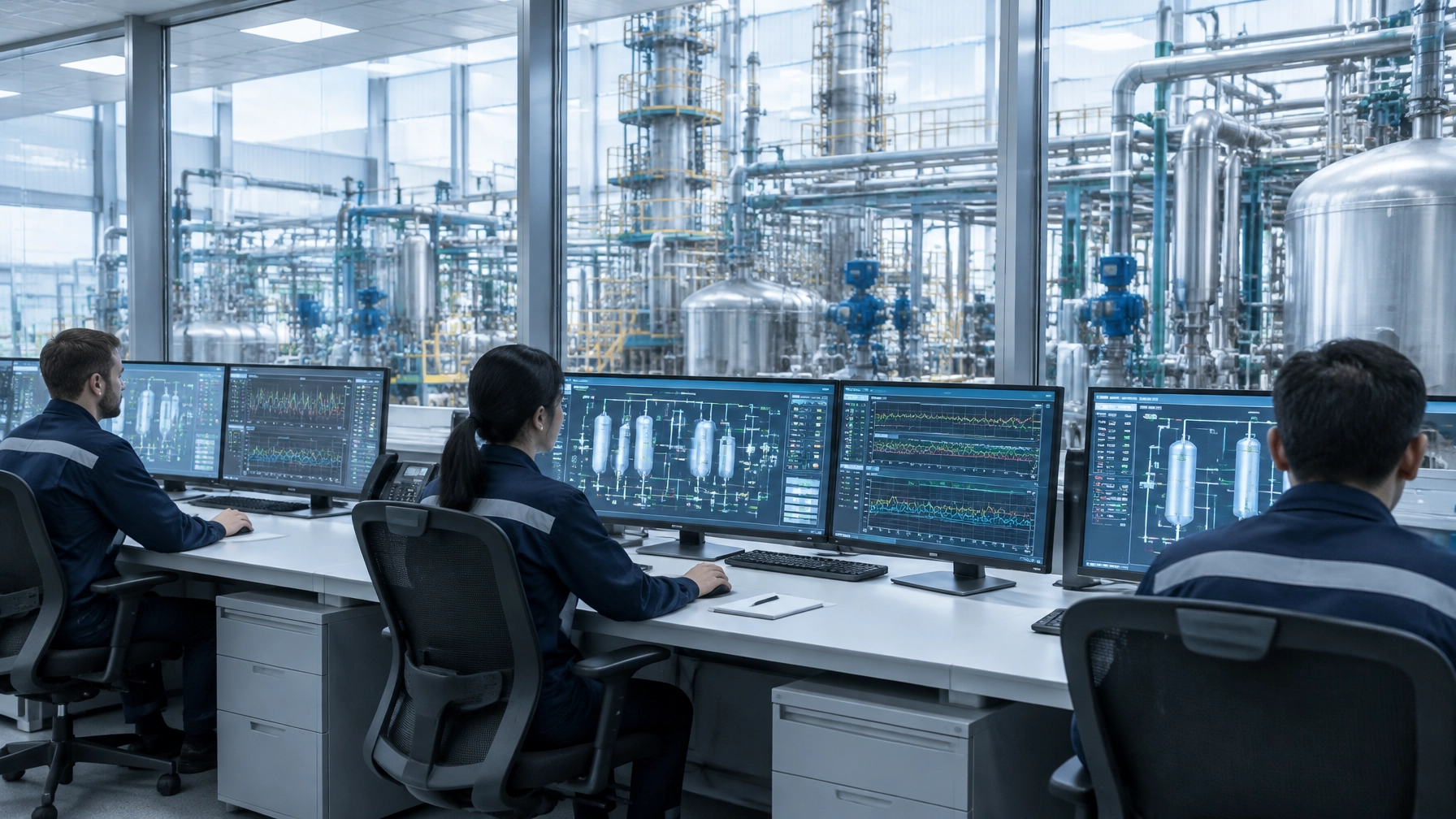
SCADA is a supervisory control and data acquisition system. It collects information from PLCs, remote terminal units, sensors, and other field equipment, then presents that information through centralized software and operator interfaces.
SCADA is especially useful when assets are spread across multiple locations. Common applications include:
- Municipal water and wastewater systems
- Pump stations and reservoirs
- Electrical substations and utility networks
- Pipelines and remote infrastructure
- Multi-site manufacturing operations
- Transportation and environmental monitoring systems
A DCS is generally deployed within a plant or facility where tightly coordinated process control is required. SCADA is often deployed across a geographically distributed system where remote monitoring, data collection, and supervisory control are the primary needs.
The distinction can be summarized this way:
- DCS: Local, integrated control of a complex process plant
- PLC: Direct control of a machine, skid, or equipment group
- SCADA: Supervisory monitoring and control across local or geographically distributed assets
The technologies can also overlap. A municipal water system may use PLCs at individual treatment processes and pump stations, with SCADA providing centralized visibility across the network. A chemical manufacturer may use a DCS for plant process control while integrating PLC-controlled packaging equipment through a higher-level interface. For a deeper look at redundancy, data modeling, historians, alarms, networking, and HMI decisions, review our guide to SCADA system design.
The correct architecture depends on whether your priority is direct process regulation, machine-level control, remote asset supervision, or a combination of all three.
When Should You Choose a DCS, PLC, or SCADA System?
A DCS may be appropriate when you operate a large continuous or batch process and need:
- Centralized operation across multiple process areas
- Advanced analog and closed-loop control
- Integrated alarms, trends, and historical data
- High availability and redundancy
- Coordinated batch or recipe management
- A scalable architecture for future production needs
A PLC-based system may be the right choice when you need to control:
- A single machine or production cell
- Packaging or assembly equipment
- A material handling system
- A process skid or utility package
- Discrete sequences and equipment interlocks
- Motion or robotic applications
For robotics, CCS integrates and supports ABB Robotics systems as an authorized ABB Robotics System Integrator. We can coordinate robot programming, PLC communication, safety functions, and production equipment as part of a larger automation project.
SCADA may be the best fit when you need to:
- Monitor assets across multiple facilities
- Collect information from remote PLCs or field devices
- Provide centralized operator access
- Track trends, alarms, and system performance
- Support municipal or utility operations
- Connect plant data to reporting and business systems
What Should Manufacturers Consider Before Selecting an Architecture?
Choosing an architecture should begin with a clear understanding of your current operation and future goals. Before selecting hardware or software, we recommend that manufacturers evaluate:
Process requirements
Determine whether your operation is primarily continuous, batch, discrete, or a combination. Analyze the number and type of control loops, equipment sequences, alarms, safety functions, and operator interactions required.
Existing equipment
Legacy PLCs, HMIs, drives, instrumentation, and networks may be valuable assets. A well-planned upgrade can modernize the system without requiring an unnecessary replacement of every component.
Availability and safety
Consider the operational and financial impact of downtime. Critical processes may require redundancy, secure communications, documented backups, and carefully managed change procedures.
Data and reporting
Identify which process information your operators, maintenance team, production managers, and business leaders need. Platforms such as Ignition and AVEVA can provide visualization, reporting, historian, and supervisory capabilities when properly engineered.
CCS is an Ignition Credentialed Integrator and an AVEVA Registered System Integrator. We also maintain verified credentials with Rockwell Automation. These partnerships complement our practical experience with control system engineering and integration.
Physical infrastructure
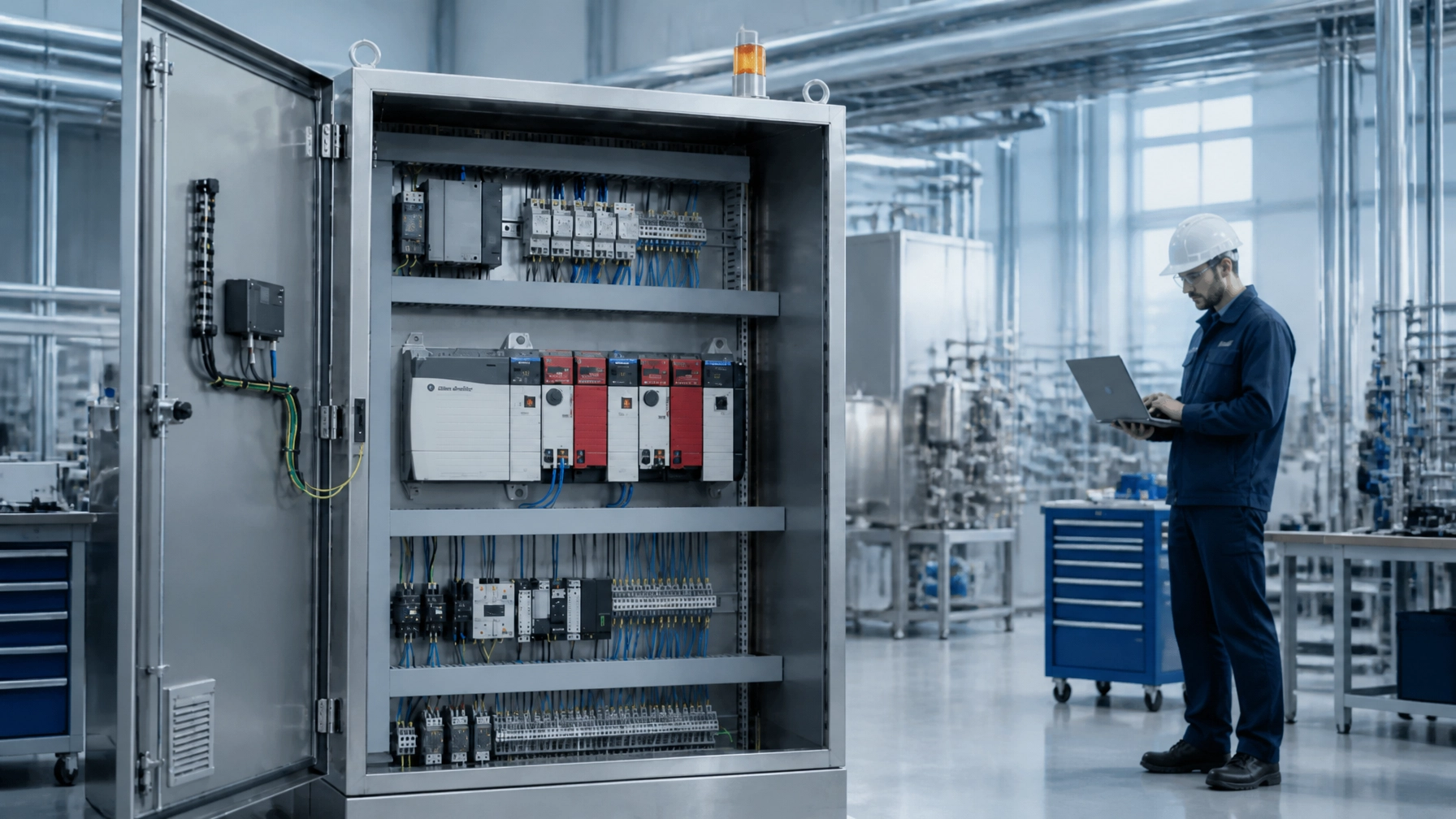
The control architecture must be supported by reliable electrical infrastructure. That may include new enclosures, network equipment, power distribution, instrumentation, and field wiring.
CCS designs and fabricates UL 508A Listed industrial control panels for new, custom, OEM, and retrofit applications. Our engineers coordinate panel design with the PLC program, network plan, field devices, and installation requirements.
CCS Supports the Full Automation Lifecycle
Whether you have an aging PLC, a new process line, a geographically distributed water system, or a plant-wide modernization project, the best solution begins with an objective evaluation.
Our team can analyze your current architecture, corroborate your operational requirements, develop a practical design, and support implementation through testing, commissioning, training, and ongoing upkeep. We provide consulting, engineering, control system upgrades, system support, on-site services, PLC programming, SCADA integration, DCS support, and industrial control panel design and fabrication.
CCS combines the resources of a large integrator with a highly personalized, client-focused experience. We serve manufacturers in Central Pennsylvania, including Lebanon, Harrisburg, Lancaster, Allentown, and Philadelphia, as well as customers throughout the surrounding Mid-Atlantic states.
From a focused programming job to a large-scale distributed control system, we can help you initiate the right project and equip your operation for current and future needs.