
Industrial Control System Upgrades and PLC Migration Services
Aging control systems can become increasingly difficult to support. Replacement parts may be scarce, programming software may no longer run on modern computers, and undocumented changes can make even routine troubleshooting risky. At the same time, an outdated system may limit production improvements, equipment integration and access to reliable operating data.
Complete Control Solutions provides industrial control system upgrades, PLC migrations and automation modernization services for manufacturers throughout Pennsylvania and the Mid-Atlantic. Our engineers evaluate the existing equipment, identify operational risks and develop a practical upgrade plan based on your production requirements, maintenance resources and available shutdown windows.
Whether you need to replace one obsolete controller or modernize an entire production line, CCS can manage the project from the initial assessment through installation, commissioning and long-term support.
When Is It Time to Upgrade a Control System?
A control system does not necessarily need to be replaced simply because it is old. However, continuing to operate unsupported equipment can increase maintenance costs and production risk.
Common signs that an automation upgrade should be evaluated include:
PLC, HMI or I/O components that are obsolete or difficult to purchase
Replacement parts available only through secondary markets
Programming software that requires an unsupported operating system
Missing or outdated PLC and HMI program backups
Recurring communication faults or unexplained equipment stoppages
Insufficient controller memory, network capacity or I/O for planned expansion
Control panels that no longer match current drawings
Limited access to production data, alarms or performance information
Uncontrolled or insecure remote-access methods
A growing dependence on one employee or contractor who understands the system
Difficulty integrating new machines, robots, drives or plant-level software
For a detailed decision framework, read ControlLogix vs. Legacy PLC Systems: When Is an Upgrade Worth It?
CCS can perform a control-system assessment before recommending a replacement strategy. This helps distinguish components that need immediate attention from equipment that can remain in service during a phased modernization.
What CCS Can Upgrade
Control system upgrades often involve more than replacing a PLC. A successful project must account for the interaction between controllers, field devices, operator interfaces, networks, panels and production systems.
CCS can upgrade or integrate:
PLCs, programmable automation controllers and remote I/O
HMI terminals and operator interface applications
SCADA systems, alarm management and historical data collection
Industrial Ethernet and control networks
Variable-frequency drives and motion-control equipment
Industrial control panels and electrical distribution components
Safety controllers and related control architecture
Instrumentation and process-control devices
Communication gateways and protocol converters
Connections to databases, reporting systems and plant software
Robotics and automated material-handling equipment
Our engineers review the complete control architecture so that a replacement in one area does not create compatibility problems elsewhere.
Legacy PLC Migration and Modernization
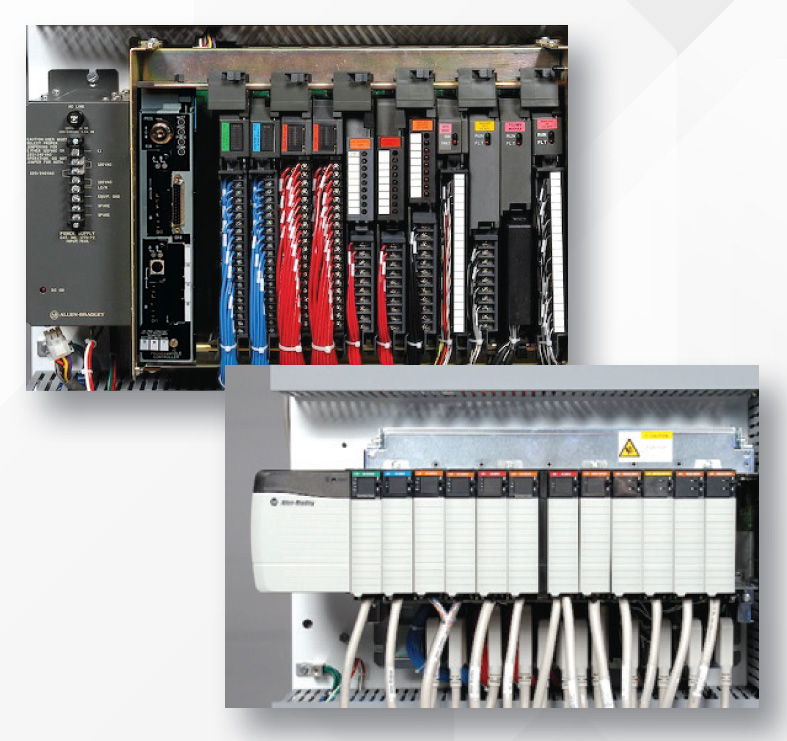
Legacy PLC migrations require careful planning. Existing programs may contain years of production knowledge, operator adjustments and troubleshooting changes that are not documented anywhere else. A direct code conversion without understanding the process can preserve old problems or introduce new ones.
CCS evaluates the original PLC logic, I/O configuration, communications, HMI application and connected equipment before developing the replacement system. We can assist with migrations from legacy Allen-Bradley platforms such as PLC-5 and SLC 500, along with other obsolete or unsupported control platforms.
Depending on the application, the project may include:
Recovering and securing the existing PLC and HMI programs
Documenting the current hardware and network architecture
Creating an I/O and device inventory
Converting or rewriting the control logic
Replacing obsolete local or remote I/O
Updating HMI screens and alarm configuration
Preserving required communication with existing equipment
Testing sequences and interlocks before installation
Developing rollback and recovery procedures
Producing updated drawings, backups and operating documentation
Learn more about moving from SLC 500 to ControlLogix and what to expect from professional Allen-Bradley PLC programming services.
A Structured Control System Upgrade Process
Every facility and production process is different, but most successful automation upgrades follow a structured process.
1. Existing-System Assessment
CCS begins by reviewing the installed controls, available documentation, program backups, spare parts, network connections and known reliability concerns. We also discuss future production plans so that the new design can accommodate reasonable expansion.
2. Upgrade Strategy and System Design
Our engineers develop an upgrade strategy based on technical risk, production priorities and shutdown availability. The design may call for a complete migration, a phased upgrade or replacement of the most critical components first.
3. Software Development and Conversion
PLC logic, HMI applications, alarms, recipes and communications are converted or redeveloped as required. Whenever practical, this work is completed and tested offline before the production shutdown.
4. Panel Modification and Factory Testing
CCS can design and build new industrial control panels or modify existing panels when conditions permit. Hardware and software can be tested together before shipment through a factory acceptance test.
5. Installation and Scheduled Cutover
Installation activities are coordinated around the plant’s operating schedule. Detailed cutover plans help organize wiring changes, equipment replacement, program installation and verification tasks during the available shutdown window.
6. Startup, Commissioning and Documentation
After installation, CCS verifies I/O, communications, safety functions, equipment sequences and operator controls. Final program backups, drawings and supporting documentation are updated to reflect the installed system.
Phased Automation Upgrades
A complete control-system replacement is not always practical during a single shutdown. CCS can develop a phased modernization plan that distributes the work across multiple projects or scheduled outages.
For example, a facility may begin by replacing an obsolete PLC while temporarily retaining compatible I/O and field devices. HMI, networking and data-collection improvements can then be completed in later phases. Another facility may first standardize its network and program backups before migrating individual production lines.
A phased approach can help manufacturers:
Address the highest operational risks first
Coordinate upgrades with planned maintenance outages
Spread capital spending across multiple budget periods
Preserve usable equipment where appropriate
Prepare infrastructure for future automation projects
Reduce the amount of change introduced during one shutdown
Each phase should still support a defined long-term architecture. CCS documents the planned transition so that short-term decisions do not interfere with later improvements.
PLC, HMI, SCADA and Network Integration
Modern automation systems depend on reliable communication between plant-floor equipment and higher-level applications. CCS can integrate PLCs, HMIs, SCADA platforms, drives, robots, instrumentation and production databases as part of a control system upgrade.
Our engineers work with Rockwell Automation systems and platforms such as Ignition and AVEVA while also supporting facilities with mixed-vendor equipment. Integration may include EtherNet/IP, Modbus, OPC UA and other industrial communication protocols, depending on the installed equipment.
CCS is a Rockwell Automation Bronze Level System Integrator, an Ignition Credentialed Integrator, an AVEVA Registered System Integrator and an ABB Authorized Robotics System Integrator.
Explore our Rockwell Automation integration services and broader industrial automation engineering capabilities.
Improving Cybersecurity and Maintainability
A system upgrade is also an opportunity to improve how the control environment is maintained and protected. Cybersecurity does not depend on one product or setting. It requires a combination of appropriate architecture, access controls, backups, documentation and ongoing maintenance.
Depending on the application, CCS can help incorporate:
Segmentation between business and industrial control networks
Managed switches and documented network architecture
Role-based user access
Controlled remote-access methods
Current PLC, HMI and SCADA program backups
Backup and restoration procedures
Alarm and event logging
Standardized device naming and addressing
Firmware and software lifecycle planning
Updated electrical and network drawings
These improvements can make the upgraded system easier to troubleshoot, recover and support throughout its operating life.
Why Manufacturers Choose Complete Control Solutions
CCS combines local responsiveness with the engineering resources required for complex industrial automation projects. Our team can support the full upgrade lifecycle, including assessment, design, programming, panel fabrication, installation, commissioning and ongoing system support.
Customers work with CCS for:
Experience with operating manufacturing facilities and legacy equipment
Practical upgrade plans built around production requirements
PLC, HMI, SCADA, networking and panel expertise within one team
Support for both complete migrations and phased modernization
Thorough testing and commissioning
Updated program backups and system documentation
Ongoing control-system support
We serve manufacturers in Lebanon, Harrisburg, Lancaster, York and throughout Central Pennsylvania, as well as customers across Maryland, Delaware, New Jersey and the wider Mid-Atlantic region.
Frequently Asked Questions
Can CCS upgrade a control system without replacing everything?
Yes. If compatible equipment remains serviceable, CCS can evaluate a phased upgrade that replaces the highest-risk components first. The recommended approach depends on hardware compatibility, system condition and the facility’s long-term plans.
How does CCS minimize downtime during a PLC migration?
Downtime planning may include offline software development, advance panel fabrication, factory testing, detailed cutover procedures and coordination with planned shutdowns. The exact strategy depends on the system and production schedule. For a detailed assessment, testing, cutover, rollback, and training framework, read How to Plan a Legacy PLC Migration Without Disrupting Production.
Can existing PLC and HMI programs be converted?
In many cases, existing programs can be converted or used as the basis for a new application. CCS reviews the original logic and operator interface to determine what can be retained and what should be rewritten or improved.
What documentation is provided after an upgrade?
Project documentation can include PLC and HMI program backups, electrical drawings, network information, hardware lists and operating documentation. The required deliverables are defined during the project-planning stage.
Plan Your Control System Upgrade
If obsolete controls, unavailable replacement parts or recurring system problems are affecting your operation, CCS can help you evaluate the available options. We will review the existing system, discuss production requirements and develop an upgrade strategy that fits your facility.
Contact Complete Control Solutions to discuss your PLC migration or industrial control system upgrade.