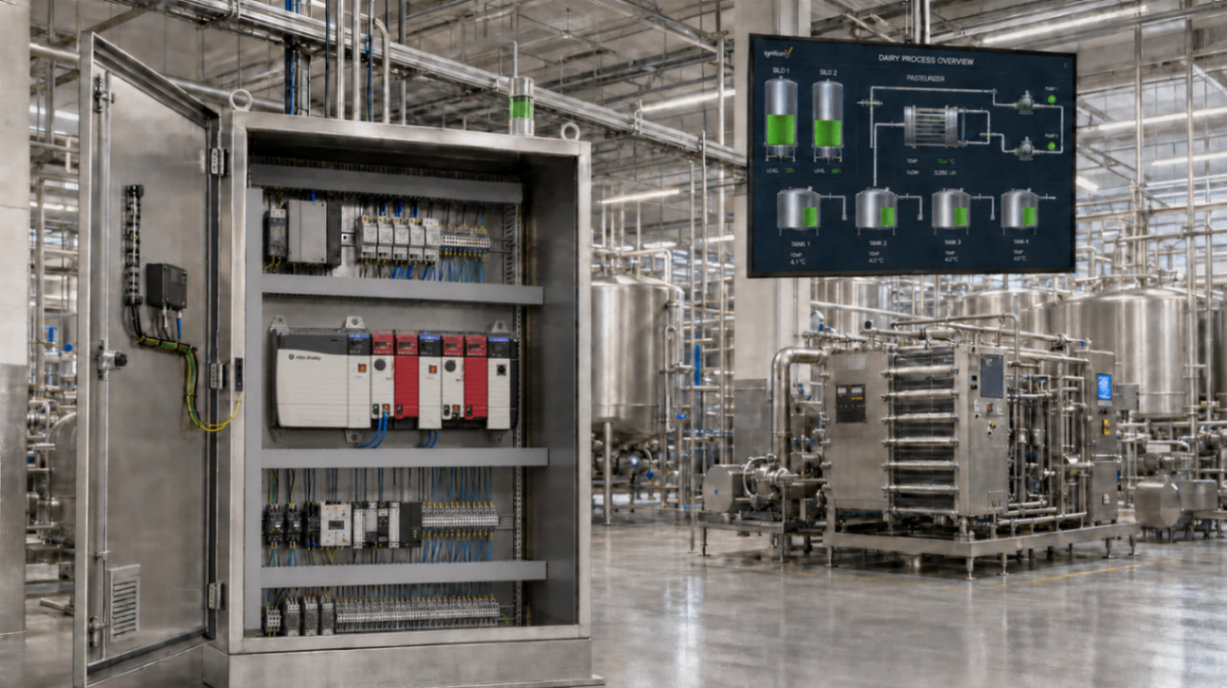
Manufacturing operations depend on control systems that perform consistently, communicate clearly, and support future growth. When an Allen-Bradley PLC controls a critical machine or production process, the quality of its programming directly affects uptime, safety, efficiency, and product quality.
Whether you need a small programming update, a new control system, or a complete modernization project, choosing the right programming partner is critical. Professional Allen-Bradley PLC programming services in Pennsylvania should include far more than writing ladder logic. You should expect a coordinated process that addresses system architecture, HMI development, I/O configuration, industrial networking, testing, commissioning, documentation, and long-term support.
At Complete Control Solutions (CCS), we help manufacturers throughout Central Pennsylvania and the Mid-Atlantic design, implement, and maintain robust Rockwell Automation control systems.
What Allen-Bradley PLC Programming Includes
Allen-Bradley PLC programming can support everything from a single machine to a large-scale distributed control system. The scope of work depends on your process, equipment, production goals, and existing infrastructure.
A professional programming partner should begin by analyzing your application and documenting how the system needs to operate. This typically includes:
- Process sequences and operating modes
- Equipment start-up and shutdown procedures
- Automatic and manual controls
- Interlocks and permissives
- Alarm conditions and operator responses
- Safety requirements
- Analog signal scaling and control loops
- Communication between PLCs, HMIs, drives, and field devices
- Production data and reporting requirements
This planning phase helps ensure that the finished program reflects your actual process rather than relying on generic templates. Our engineers work closely with your operations, maintenance, and engineering teams to corroborate requirements and develop a solution aligned with your specific needs and expectations.
ControlLogix and CompactLogix Programming
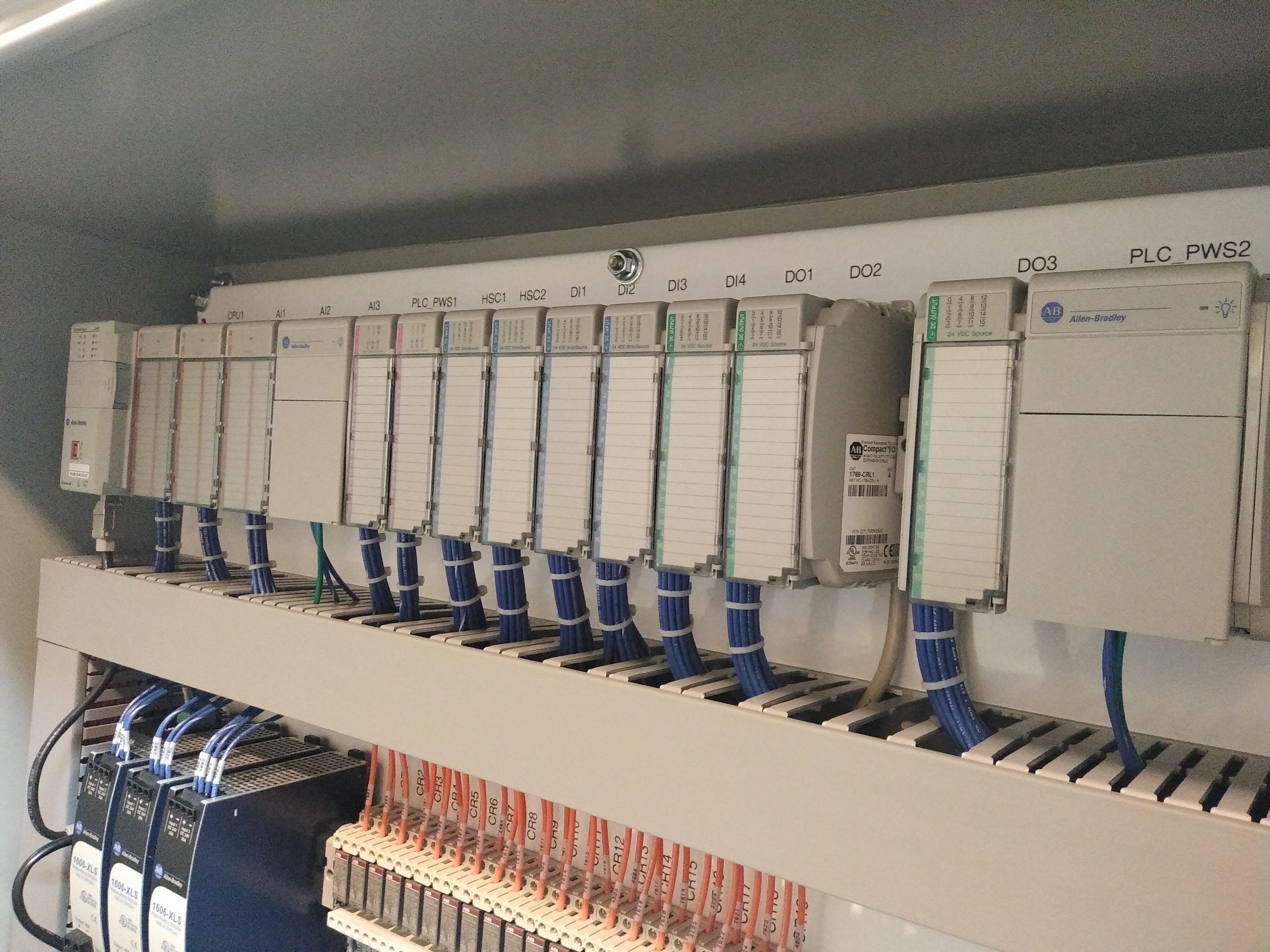
The Allen-Bradley Logix platform provides a scalable foundation for modern manufacturing systems. Depending on the size and complexity of your application, your project may use ControlLogix, CompactLogix, or a safety controller such as GuardLogix.
Rockwell Automation CompactLogix 5380 controllers are designed for applications requiring scalable control, communications, I/O, motion, or safety capabilities. ControlLogix systems are often used for larger applications requiring higher capacity, distributed control, or integration across multiple production areas.
Your programming partner should be able to:
- Select an appropriate controller and I/O architecture
- Configure local and remote I/O
- Develop reusable routines and Add-On Instructions
- Structure tasks, programs, and routines logically
- Configure motion and drive control where required
- Implement alarms, diagnostics, and fault handling
- Support phased expansions and future equipment additions
- Integrate safety functions according to the project requirements
The objective is not simply to make the equipment run. The objective is to create a maintainable control system that your team can understand, troubleshoot, and expand over time.
Studio 5000 Programming and Project Development
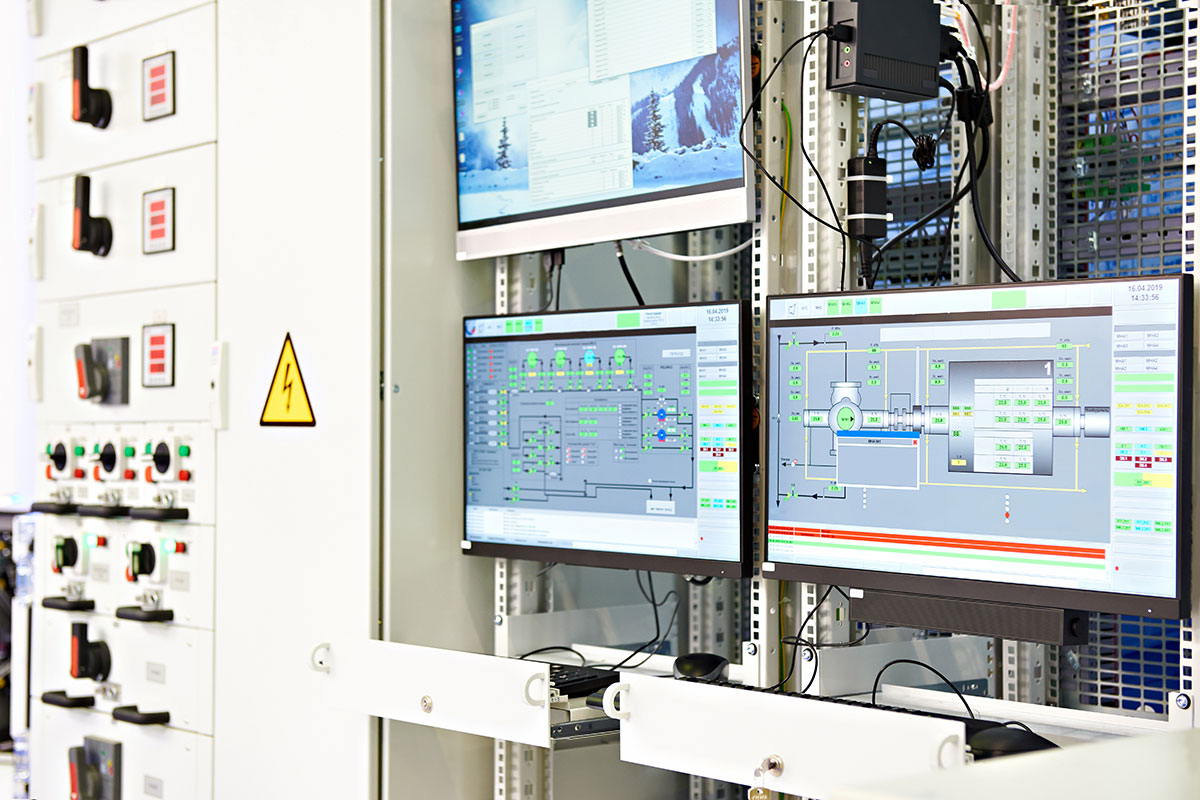
Modern Allen-Bradley Logix systems are programmed using the Studio 5000 environment. Studio 5000 Logix Designer provides the programming environment for developing and maintaining Logix controller applications.
A professional Studio 5000 project should be organized around clarity and consistency. Meaningful tag names, descriptive comments, logical routines, and consistent programming standards make a significant difference when your maintenance team needs to diagnose an issue during production.
Depending on the application, programming may include:
- Ladder logic
- Structured text
- Function block programming
- Sequencing and state-based control
- Recipe and batch functionality
- PID control
- Equipment interlocks
- Production counters and runtime tracking
- Fault detection and recovery routines
- Data structures and user-defined types
Our engineers can develop a new Studio 5000 application, modify an existing program, or help migrate an outdated control platform to current hardware and software. CCS engineering services support projects from initial design through drawing package development and implementation.
HMI Development and Operator Interface Design
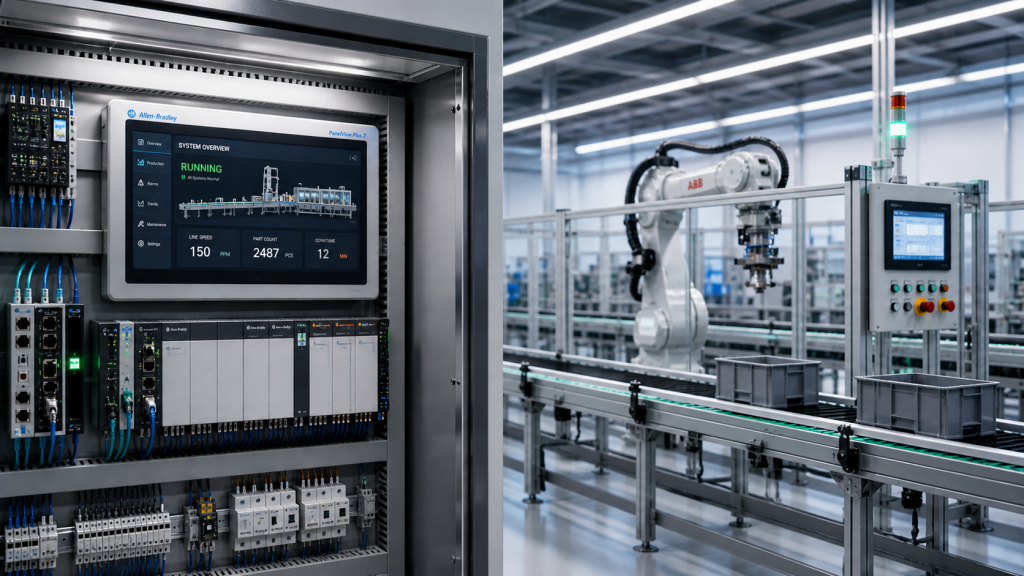
PLC programming and HMI development should be approached as one integrated project. The PLC controls the process, while the HMI gives operators and maintenance personnel the information they need to run and support it.
A well-designed HMI should provide clear visibility into:
- Equipment status
- Process values
- Active alarms
- Historical alarm conditions
- Manual controls
- Maintenance diagnostics
- Production counts
- Trends and key performance indicators
- Recommended corrective actions
CCS provides FactoryTalk View development and operator interface design as part of our Rockwell Automation capabilities. We align HMI tags with the PLC program to reduce mapping errors and make the system easier to support.
Whether your operation uses PanelView terminals, a plant-wide visualization system, or another compatible platform, the interface should be intuitive for operators and informative for maintenance personnel. Clear navigation and consistent alarm handling can reduce response time and help prevent minor faults from becoming extended downtime events.
I/O Configuration and Industrial Networking
A reliable PLC program depends on accurate I/O configuration and dependable communication between system components. This includes configuring digital and analog modules, remote I/O racks, variable frequency drives, servo systems, safety devices, barcode equipment, instrumentation, and other networked assets.
Your programming partner should verify:
- Input and output types
- Module locations and slot configurations
- Analog signal ranges and scaling
- Device addresses and communication paths
- Data types and tag structures
- Network loading and device status
- Fault handling for lost communications
- Connections to drives, HMIs, and remote devices
Modern Allen-Bradley systems commonly use EtherNet/IP for communication among controllers, I/O, drives, HMIs, and other automation equipment. A professional integrator should also help design the network architecture, select appropriate hardware, and document device connections and IP addressing.
For larger systems, managed switches, segmented networks, and ring or redundant topologies may be appropriate. For legacy systems, the project may also require a plan for integrating or migrating older ControlNet or DeviceNet equipment.
CCS industrial networking design services can help equip your operation with a network that supports reliable communications today and future system expansion.
Testing Before Production Startup
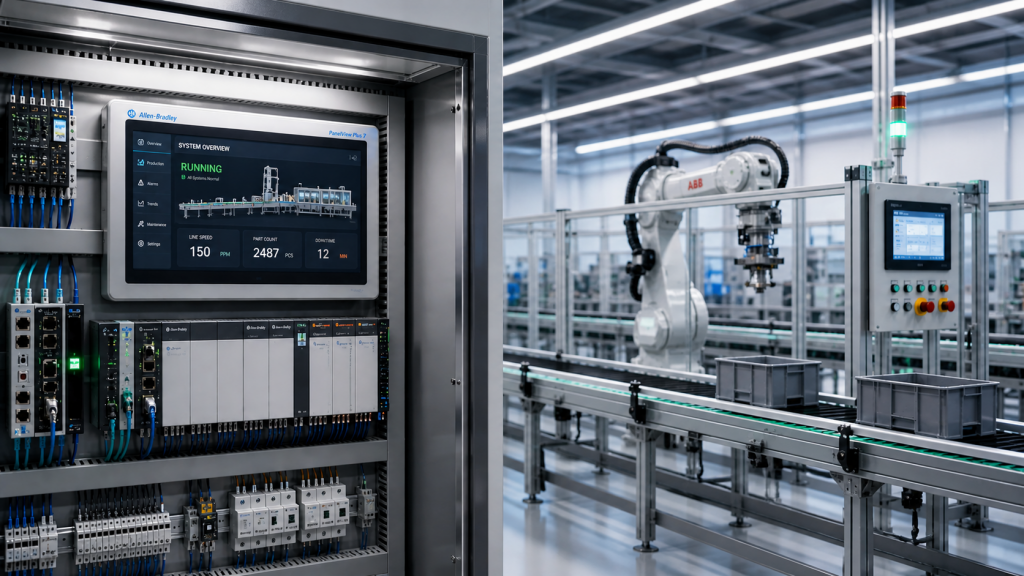
One of the most important expectations for professional Allen-Bradley PLC programming services is a defined testing process. Testing should begin before the program is connected to live production equipment.
Depending on the project, testing may include:
- Program review: Engineers inspect the logic, tag structure, sequencing, alarms, and safety-related functions.
- Bench testing: PLC and HMI applications are tested using simulated or controlled I/O where possible.
- Factory Acceptance Testing: The project team verifies the system against documented functional requirements before shipment or installation.
- Site Acceptance Testing: The installed system is tested under actual field conditions.
- Operational testing: Operators and maintenance personnel review normal operation, startup, shutdown, and fault scenarios.
Rockwell Automation’s Studio 5000 design environment also includes tools that can support code validation, emulation, and virtual design depending on the application.
Testing cannot eliminate every startup issue, but it can identify problems earlier, when they are less disruptive and less expensive to correct.
Commissioning and Startup Support
Commissioning is where the control system, electrical equipment, field devices, and production process are brought together. A qualified partner should provide structured on-site support rather than simply downloading a program and leaving your team to resolve the remaining issues.
Commissioning activities may include:
- Verifying each I/O point from the field device to the PLC tag
- Checking motor rotation and drive operation
- Confirming network communications
- Testing permissives and interlocks
- Reviewing safety circuits and fault responses
- Scaling and calibrating analog instruments
- Tuning PID loops
- Testing HMI commands and alarm messages
- Running normal and abnormal operating scenarios
- Training operators and maintenance personnel
CCS provides control system upgrades and commissioning support for new and existing systems. Where appropriate, we can also help structure an upgrade in phases to reduce the impact on production and distribute project costs over time.
Documentation for Long-Term Upkeep
A PLC program without accurate documentation can become difficult to maintain, especially when the original programmer is no longer available. Complete project documentation should be treated as a deliverable: not an optional extra.
Your documentation package may include:
- Final PLC and HMI project files
- Electrical schematics
- I/O lists
- Network architecture diagrams
- Panel layouts
- Device and component schedules
- IP address assignments
- Alarm descriptions
- Operator instructions
- Backup procedures
- Change logs and revision history
- As-built drawings
CCS develops schematic drawing packages and system documentation to support general upkeep and maintenance. Clear documentation gives your team the tools needed to troubleshoot confidently and make future changes without unnecessarily increasing risk.
How to Minimize Production Disruption
Manufacturers often delay PLC programming or modernization work because they are concerned about downtime. Those concerns are understandable, but a well-planned project can significantly reduce production disruption.
Start by defining the scope and identifying the equipment that cannot be unavailable during normal production. From there, your integrator can develop a practical implementation plan that may include:
- Conducting a site assessment before programming begins
- Reviewing existing PLC code and electrical drawings
- Backing up current PLC, HMI, and drive configurations
- Programming and testing off-line
- Prebuilding and testing control panels
- Scheduling cutovers during planned downtime
- Preparing a rollback plan
- Reusing proven control strategies where appropriate
- Performing I/O checkout in a structured sequence
- Training plant personnel before startup
- Providing on-site and remote support after commissioning
Open, fluent communication is essential throughout this process. Your programming partner should provide clear project milestones, identify risks early, and coordinate with the people who operate and maintain your equipment every day.
Ongoing Troubleshooting and Support
Your needs do not end when the system is commissioned. Production changes, new equipment, software updates, component obsolescence, and process improvements can all create new programming requirements.
CCS provides system support, including remote assistance, emergency support, product end-of-life guidance, and process improvement services. Our engineers can help troubleshoot faults, analyze system performance, improve existing logic, and plan future upgrades.
As a Rockwell Automation Bronze Level System Integrator, CCS supports manufacturers in Lebanon, Harrisburg, Lancaster, York, and throughout Central Pennsylvania, as well as surrounding areas in Maryland, Delaware, New Jersey, and the broader Mid-Atlantic region.
Choose a Partner for the Full PLC Lifecycle
Professional Allen-Bradley PLC programming services should equip your operation with more than functional code. You should receive a robust, well-documented, tested, and maintainable control solution supported by engineers who understand your process and future needs.
Whether you need ControlLogix programming, CompactLogix development, Studio 5000 support, HMI integration, industrial networking, troubleshooting, or a complete commissioning plan, CCS can support your project from start to finish.
Contact Complete Control Solutions to discuss your Allen-Bradley PLC programming project. We will analyze your current system, understand your goals, and help identify the right path forward for reliable, state-of-the-art automation.